.svg)


.svg)

share


Demand for Life Plan Communities is not a forecast. It is a present condition. Providers across the country are experiencing high occupancy, expanding waitlists, and accelerating demographic growth against a backdrop of constrained new development.
The opportunity is not difficult to identify. Execution is.
While many providers recognize the need to grow, far fewer are structurally prepared to advance growth initiatives in today’s environment where construction inflation, workforce pressure, aging physical plants, and capital complexity are reshaping how growth must be evaluated, sequenced, and financed.
Is your organization built to support and manage growth — one that supports active decision making and risk management to maximize the opportunity?
The Demand Supercycle
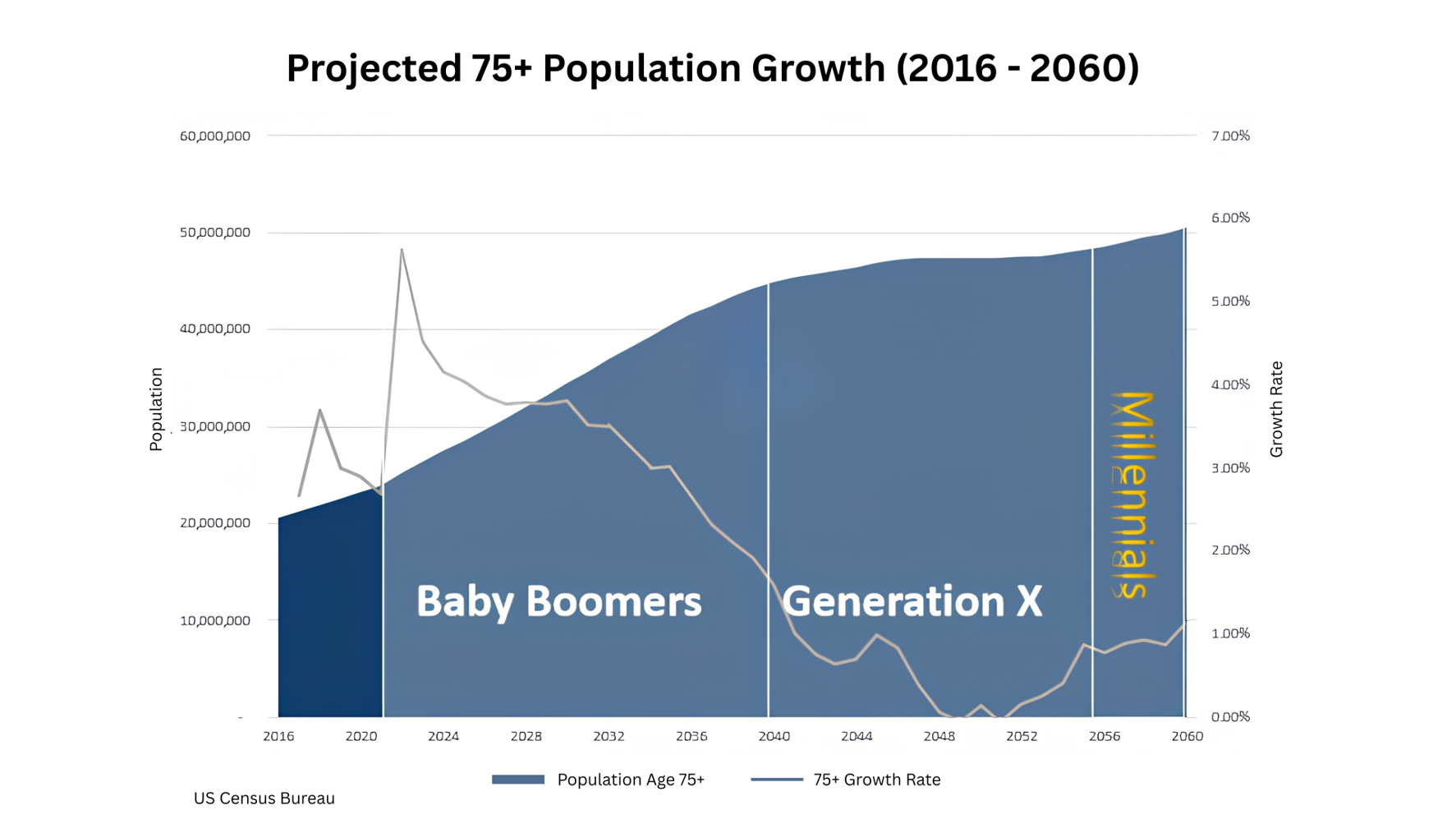
The senior living industry is entering a prolonged demographic expansion cycle that will redefine competitive positioning over the next two decades. The 75-plus population begins accelerating meaningfully in 2027 and continues expanding through 2035 and beyond. The chart below shows the projected growth of the 75-plus population over the next 30 years.
Despite continued growth in the number of occupied units nationwide, NIC MAP's first quarter 2026 data reported a record low year-over-year inventory growth at 0.4% with new units under construction at their lowest level since 2012. In fact, nearly 60 percent of all NIC MAP-tracked markets currently have zero active construction projects. The result (and opportunity) is an increasing gap between supply and demand for senior living product.
A New Consumer Profile
In addition to the demand supercycle, organizations are navigating rapidly evolving consumer expectations. Incoming residents are wealthier, more informed, and increasingly unwilling to compromise on product quality, wellness integration, personalization, and aging-in-place flexibility. Households 75 and older with incomes exceeding $100,000 grew 12 percent year over year, while median home sale prices rose 9 percent, according to research from NORC at the University of Chicago, a consumer profile that is reshaping what Life Plan Communities must deliver to remain competitive.
Many communities were not built for this consumer, and the organizations positioned to lead over the next decade will be those capable of adapting their strategy, product offering, and capital structure quickly enough to respond to these changing market conditions.
Execution Starts With Integration
Growth in senior living is no longer primarily a development question. It has become one of organizational preparation and capability. The most critical work in any growth initiative happens before land is purchased or an architect puts "pencil to paper". Organizations that succeed establish why growth is essential to the mission, define what success looks like for a project (not just financial parameters), and secure board and leadership alignment before proceeding.
Greystone's planning process moves organizations through a deliberate sequence — defining objectives, evaluating market dynamics, tailoring product offerings to this new customer, evaluating project economics, defining a plan of finance, creating a master site plan, and establishing a project timeline.
As Stuart Jackson, Greystone's Chief Growth and Strategy Officer, notes, many organizations recognize the need to grow but stall when translating that intent into action. "The differentiator is not access to opportunity — it's having the experience, bandwidth, and integrated planning capacity to act on it effectively. Providers that succeed are integrating market intelligence, capital planning, and operational readiness from the start — moving forward with clarity where others hesitate."
Growth Requires Capital Strategy
Today's capital environment is not the barrier most organizations believe it to be. “The demand fundamentals for Life Plan Communities have rarely been stronger, and today’s capital markets are more accommodating than many organizations realize,” notes Tad Melton, Managing Director at Ziegler.
One financing structure that is proven and supports growth initiatives is Bond Anticipation Notes (“BANs”), a financing option that allows providers to access non-recourse pre-finance seed capital while preserving balance sheet flexibility. For organizations that have secured a site, received land use approvals, assembled a qualified development team, and established a credible path to long-term financing, BANs offer a meaningful mechanism for advancing projects while managing risk to the organization.
The Growth Models Are Changing
Providers must evaluate how they can adapt and change their current offerings to serve the upcoming generation of consumer. Growth strategy is no longer a single-path decision. The organizations successfully advancing growth today are doing so through a range of models — satellite campuses, new campus development, and existing campus repositioning and expansion.
Satellite campuses offer providers a lower-risk option of a new campus by not replicating the full continuum in a new campus. New campus development offers the opportunity to introduce new product and service delivery models. Repositioning and expanding aging assets, meanwhile, restores competitive relevance for today’s consumer while often preserving capital capacity for future off-campus growth. Where balance sheets are stronger and/or demand is present, concurrent execution of new or satellite campus development and repositioning and expansion offers a path to scale that achieves maximum impact.
Across all of these pathways, site control is a foundational prerequisite that organizations consistently underestimate. Identifying the right site and a willing seller can take years — which is why initiating a land search in concert with a business planning effort is a critical early step in any growth initiative.
The Window Is Narrowing
The demand is present. The opportunity is clear. Providers that are looking to take advantage of this demand supercycle should begin planning now. The organizations that act earliest will be best positioned to shape their future position in the market.
For boards and leadership teams, the conversation is no longer whether growth should occur, but how to approach growth in a way that aligns mission, market opportunity, capital capacity, and long-term organizational sustainability.
.svg)

.svg)

-min.png)
.svg)