.svg)


.svg)
.png)
share


At The Greystone Event 2026 at the Omni Las Colinas in Irving, Texas, one message came through clearly: senior living has entered a favorable market window. Occupancy is improving, waitlists are strengthening, new construction remains constrained, and the next generation of residents is already reshaping the market. But demand alone will not create advantage. The organizations that benefit most will be those that make earlier, clearer decisions about growth, communicate the consumer value proposition, and exhibit the operating discipline required to deliver that value consistently.
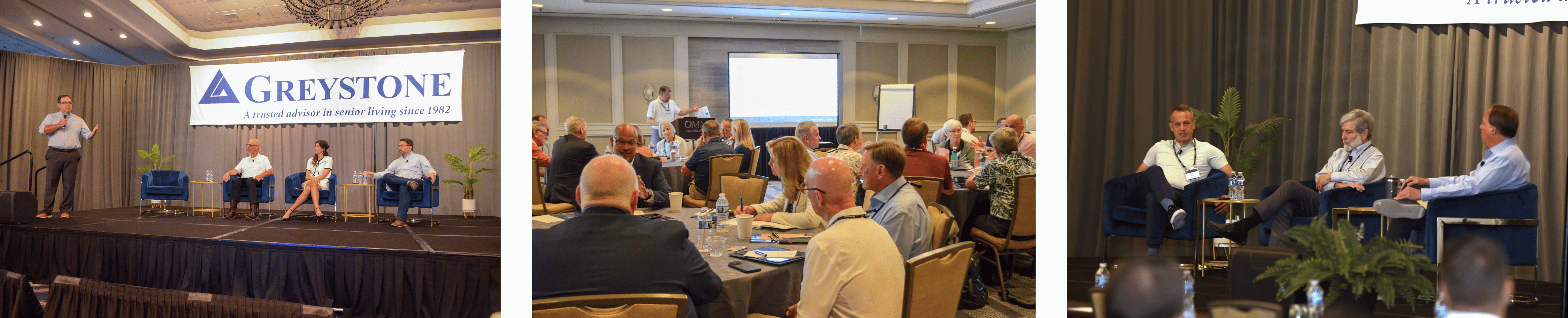
The Event opened with a dedicated CEO and Board Member forum to examine how boards and executive leadership teams can align more effectively around growth, capital allocation, market relevance, and organizational priorities. The forum reinforced an important governance discipline: boards create the most value when they stay focused on long-term strategic direction, while management provides the context, analysis, and recommendations needed for informed decisions.
Greystone Co-CEO Mark Andrews carried those leadership themes forward in his Thursday session, “Why the Best Organizations Win When the Box Gets Smaller.” The session framed today’s environment as one in which every organization is operating inside a tighter box of capital, labor, time, and legacy operating models. Mark’s message was direct: constraints do not determine outcomes; leadership response does. Winning organizations decide faster, choose fewer priorities, stop protecting activities that no longer fit, and apply a disciplined filter to major decisions: does this strengthen strategic position, simplify execution, and earn the scarce resources it requires?
The Event’s Broader Operating Mandate
From the CEO and Board Member forum through the broader Event program, the leadership mandate was consistent. Operating fundamentally differently is not about a single initiative, program, or innovation. It is a more disciplined way of leading: moving from reactive planning to intentional growth decisions, from provider-centered offerings to consumer-defined value propositions, from functional silos to integrated execution, and from broad strategy to measurable operating discipline. Demand may create opportunity, but disciplined leadership determines who captures it.
Growth Is a Leadership Decision
Growth was one of the clearest tests of that leadership discipline. Strong demographics, limited new supply, and improving occupancy create opportunity, but they do not eliminate the need for judgment. Organizations still have to decide where to invest, what to modernize, how to differentiate, and how much risk they are prepared to take in pursuit of long-term relevance.
The growth discussion made clear that expansion is not one decision, but a set of related strategic choices. In a session moderated by Greystone President Brad Straub, Josh Ashby, CEO of Fleet Landing, and Bern Beecham, Board Chair of Channing House, discussed how organizations with different market realities evaluate expansion through the lens of mission, financial objectives, capital capacity, and governance alignment. In a separate session moderated by Greystone Chief Growth and Strategy Officer Stuart Jackson, Maria Timberlake, Vice President of Senior Living at John Knox Village, and Diane Hood, Chief Executive Officer of Mennonite Village, examined a related challenge: how mature communities can respond when products, pricing structures, and campus offerings no longer align with market expectations.
Together, those sessions underscored that growth may mean expanding capacity, affiliating with the right partner, repositioning aging assets, refreshing pricing and product structures, or investing in market-facing capabilities. The strongest organizations will not treat demand as a substitute for strategy. They will choose where to compete, what to improve, and how to align governance behind those decisions before market pressure forces the issue.
The Consumer Shift Is Raising the Bar
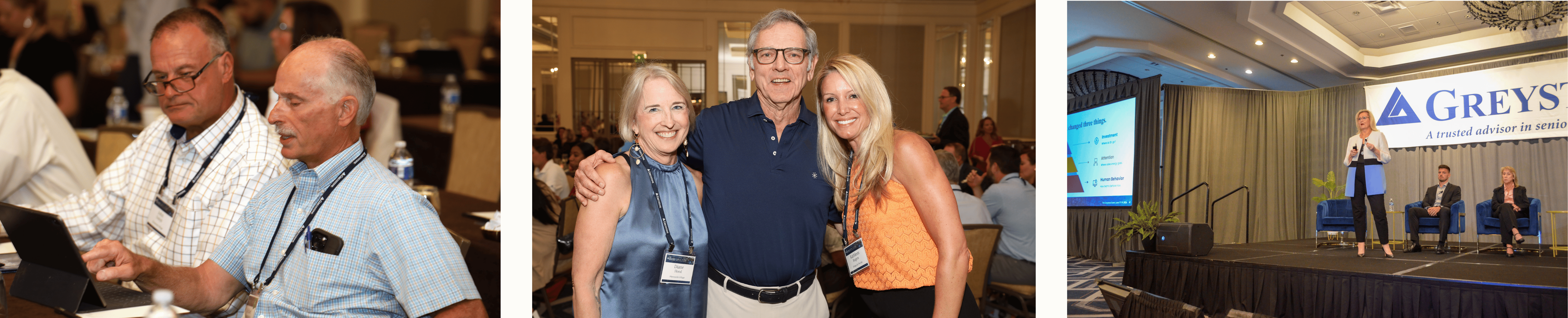
The consumer shift is no longer theoretical. In Greystone Co-CEO John Spooner’s presentation, “What Value Really Means to the Consumer,” he emphasized that providers are no longer forecasting what the next generation of residents may want; that customer is already here. The central challenge is to understand what value means through the consumer’s eyes and then equip leadership and sales teams with the clarity, positioning, and messaging needed to communicate that value with confidence.
That shift reaches far beyond product design or marketing language. Today’s consumer is informed, selective, and focused on a more personal definition of value. The competitive question is no longer simply what a community offers, but whether it can clearly explain why life will be more engaging, more connected, and more compelling for the resident.
Speakers returned repeatedly to the importance of understanding what resonates with the next generation of consumers, how longevity and lifestyle expectations are reshaping decision-making, and why organizations must define value in terms that feel relevant to residents rather than simply compelling to providers. Greystone’s point of view was direct: consumer insight only matters when it is translated into a clear, credible, and consistently delivered value proposition.
Turning Value into Market Confidence
If value is the question, proof is what gives the market confidence to believe the answer.
That was a central focus of Greystone’s Mindy Cheek and Mary Jane Fitts, who explored how leading organizations build trust by aligning messaging, expectations, and experience throughout the decision-making process. Their discussion reinforced that marketing, sales, and operations are most effective when they operate as one system: positioning creates interest, sales converts confidence, operations validates the promise, and data shows where leadership attention should go.
The same principle became tangible in a session on data and sales effectiveness, where Greystone’s Tricia Mackin, Alexei Chernikov, and Tracey Wenson demonstrated how analytics can focus resources where they create the greatest impact. Using new data analytics tools, Legacy Pointe at UCF experienced a 30 percent reduction in marketing spend while maintaining 98 percent occupancy, generating more than $2.4 million in entrance fees, and continuing to build its future pipeline. The new analytical tools provide the ability to see what is working, redirect resources quickly, and manage toward measurable performance.
Taken together, the two marketing sessions reinforced that market confidence is not created through messaging alone. It is built when organizations define value clearly, align teams around the promise, use data to concentrate leadership attention, and prove through the resident experience that the promise is real.
Delivering on the Promise
The Event also made clear that a strong value proposition is only as credible as an organization’s ability to deliver on it consistently. For many providers, that work increasingly centers on wellness, partnerships, workforce strategy, and the systems required to support all three.
David Kremer of Legacy Pointe at UCF joined Greystone’s Justin Spooner, Mark Mitchener, and Sam Martin to examine wellness not as a standalone programming initiative, but as a strategic lens shaping how residents evaluate the overall experience a community provides. Their discussion emphasized that wellness is not limited to classes or amenities. It reflects the broader question of whether the organization is delivering a lifestyle that supports how residents want to live, connect, and age.
The same logic applies to workforce strategy. Greystone’s Kristi Baird and Andrew Leech explored how providers are responding to persistent labor pressures through intentional investment in leadership development, culture, talent pipelines, and technology. Workforce strategy is no longer only an internal operating issue. It is a market-facing capability because it determines whether the promise made to prospects is delivered through the daily resident experience.
Across both sessions, the message was consistent: differentiation is not sustained by strategy alone. It is sustained by the operational discipline, talent infrastructure, leadership development, and cultural alignment required to make the promised experience real every day.

What Operating Fundamentally Differently Requires
The Greystone Event 2026 was designed to challenge providers to think beyond incremental change, and the conversations over the three days made the stakes clear. The opportunity is real, but it is perishable. Boards and executive teams should use this window to make earlier decisions about growth, sharpen the value proposition for the next generation of residents, invest in the talent and systems required to deliver it, and manage execution with greater discipline.
Operating fundamentally differently is not about a single initiative or isolated innovation. It requires leaders to bring strategy, governance, market relevance, and execution into closer alignment now, while the opportunity is still theirs to shape. The organizations that act with clarity and discipline will be best positioned to convert this market window into durable advantage.
.svg)

.svg)

-min.png)
.svg)